Privacy Hedge Alternatives: Fast-Growing Solutions for Your Backyard
Evergreen shrubs can screen a property line instead of a fence. Here is how four common choices grow, what they need, and what to weigh before planting.
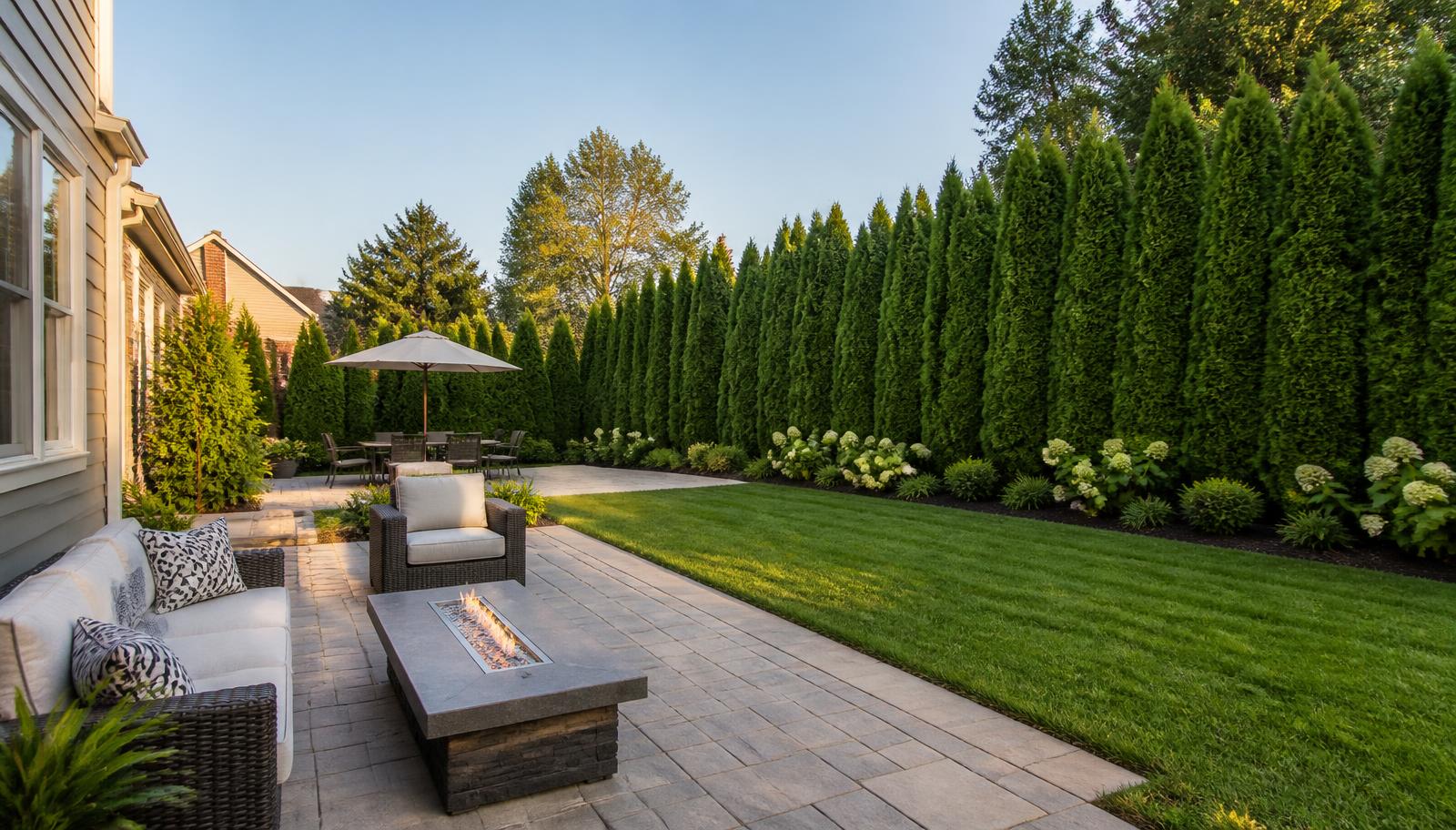
A fence gives you privacy the day it is installed, and you pay for that immediately in materials and labor. A hedge costs less at planting but asks for two or three seasons of watering and pruning before it screens anything. Which one makes sense depends on how soon you need the screen and how much yard maintenance you want.
The four evergreens below are widely sold across the US and used along residential property lines. Growth rates and plant prices vary a lot by region, nursery, pot size, soil, and how much sun the row gets, so treat the figures here as typical ranges rather than what you will pay or see in your own yard.
1. Thuja 'Green Giant' (Arborvitae): The Fast Screen
Green Giant is the usual pick when the goal is height in a hurry. It is also the one most often planted too close to a house or driveway, because a young plant hides how wide it gets.
- Growth rate: often 2 to 3 feet per year in full sun with steady water; slower in shade, heavy clay, or dry sites.
- Mature size: 30 to 40 feet tall if left alone, and it can be held near 10 to 12 feet with annual pruning.
- Cost: commonly sold in 3-gallon pots; price varies by region and nursery.
- Trade-offs: usually deer-resistant rather than deer-proof, tolerates cold wind, holds color through winter (USDA Zones 5 to 9). It needs 8 to 10 feet of width to look right.
2. 'Emerald Green' Thuja: For Narrow Side Yards
Emerald Green stays columnar, which is why it works where Green Giant does not: side yards, a strip between a patio and a fence line, a screen near a pool apron.
- Growth rate: roughly 6 to 12 inches per year, so plan on several seasons before the row closes.
- Mature size: about 10 to 15 feet tall and 3 to 4 feet wide.
- Cost: usually less per plant than Green Giant, but you need more plants for the same run.
- Trade-offs: slow to recover from winter burn or heavy snow damage, and it browns out in poorly drained soil.
3. Clumping Bamboo (Fargesia): Thick, and Not a Spreader
Do not plant running bamboo along a property line. It spreads by rhizome and becomes a neighbor problem. Clumping types such as Fargesia stay in tight clusters and expand slowly outward from where you plant them.
- Growth rate: often 1 to 3 feet per season once established; first-year growth is usually modest.
- Mature height: about 8 to 12 feet, depending on species and climate.
- Cost: varies widely by species and container size; less common at big-box stores than arborvitae.
- Trade-offs: a dense stand blocks the view of a road and softens noise, but it will not soundproof a yard. Most Fargesia prefer part shade and dislike hot, dry, exposed sites.
4. Skip Laurel (Prunus laurocerasus): Broadleaf Evergreen
Skip Laurel is the option to look at when a needled evergreen would sulk: shaded boundaries under mature oaks or maples, or the north side of a house.
- Growth rate: often around 1 to 2 feet per year with adequate moisture.
- Mature size: roughly 10 to 12 feet tall and 5 to 7 feet wide.
- Cost: comparable to arborvitae of similar pot size in most markets.
- Trade-offs: handles shade well, but it is less cold-hardy than arborvitae and the leaves and seeds are toxic if eaten, which matters in yards with young children or livestock. Check the ASPCA plant list before planting where pets browse.
Fence or Hedge: What Actually Differs
Comparing the two on price alone is misleading, because you are buying different things. A fence is a one-time purchase that starts aging immediately. A hedge is a lower up-front cost plus an ongoing commitment of water, pruning, and occasional replacement of a plant that fails.
Fence quotes depend on material, height, terrain, and local labor rates; plant costs depend on species, pot size, and how many plants your spacing requires. Get a written fence quote and a nursery price for your actual run before assuming one is cheaper.
| Factor | Wood privacy fence | Living hedge |
|---|---|---|
| Screening | Full height on day one | Two to four seasons to close in |
| Up-front cost | Higher (materials plus labor) | Usually lower per linear foot |
| Ongoing work | Occasional staining or board repair | Watering while establishing, annual pruning |
| Width used | A few inches | Several feet at maturity |
| Failure mode | Rot, leaning posts, storm damage | Individual plants die back or outgrow the space |
Frequently Asked Questions
What is the fastest growing privacy hedge in the US?
Thuja 'Green Giant' arborvitae is the fastest reliable choice, adding 3 to 5 feet per year in full sun with regular watering. Most homeowners see usable screening in two to three seasons.
How far apart should I plant privacy shrubs?
Space Green Giant arborvitae 5 to 6 feet apart, Emerald Green 3 feet apart, and Skip Laurel 4 to 5 feet apart. Closer spacing fills in faster but increases disease pressure and long-term crowding.
How far from the property line should a hedge go?
Plant at least 3 feet inside your boundary so mature growth and roots stay on your side. Many municipalities and HOAs also enforce setback rules for plantings near sidewalks and alleys.
Do living hedges really block noise?
A dense evergreen hedge will not soundproof a yard, but a thick 8-foot screen noticeably softens traffic and neighbor noise while blocking the visual source, which makes the space feel much quieter.
Is a hedge cheaper than a fence long term?
Based on market research, a hedge can cost significantly less than an installed wood fence up front, and it may appreciate in value over time. Budget for annual pruning and seasonal watering during establishment. [NAR: Remodeling Impact Report](https://www.nar.realtor/research-and-statistics/research-reports/remodeling-impact-report) [USDA NRCS: Living Fences](https://www.nrcs.usda.gov/resources/guides-and-instructions/living-fences)
Conclusion
A fence starts wearing the day it goes up; a hedge fills in as it ages, provided you water it through establishment and prune it on schedule. Choose the species for your climate and mature width first, since spacing mistakes are the hardest part to fix later. Related reading: outdated backyard trends.
About the author
Outdoor Living & Landscaping Contributor
Adilson covers topics related to gardens and outdoor spaces: planting plans, patios and pathways, drainage and slope, and the advantages and disadvantages of lawn alternatives.
More from Adilson VieiraPublished · Updated
Related articles
5 Garden Practices That May Violate Local HOA or Municipal Rules
Before starting your next outdoor project, check for these five common municipal and HOA code oversights that can lead to unexpected delays or fines.
10 Practical Backyard Landscaping Ideas That Can Help Home Value
Ten realistic backyard landscaping projects that can improve curb appeal and how a home presents to buyers, ranked by cost and effort.
Small Backyard Design Ideas for Modern Homes
How to make a small backyard feel intentional, spacious, and modern with the design moves professional landscapers use most.
30 Backyard Design Ideas for Real Yards and Budgets
Thirty backyard design ideas ranked by cost and effort — featuring planning budgets, maintenance expectations, and spatial requirements.
Fresh home & garden ideas, every Sunday.
Join American homeowners getting practical home & garden advice on gardening, landscaping, and DIY. Free, no spam, unsubscribe anytime.