Outdoor Living

Pool Deck Guide: Choosing the Right Material, Size, and Layout for Your Backyard

Everything homeowners actually need to decide on a pool deck: material comparisons with heat and slip data, honest 2026 cost ranges, sizing rules, drainage, code requirements, and a maintenance plan that keeps the surface safe for decades.

By 21 min read
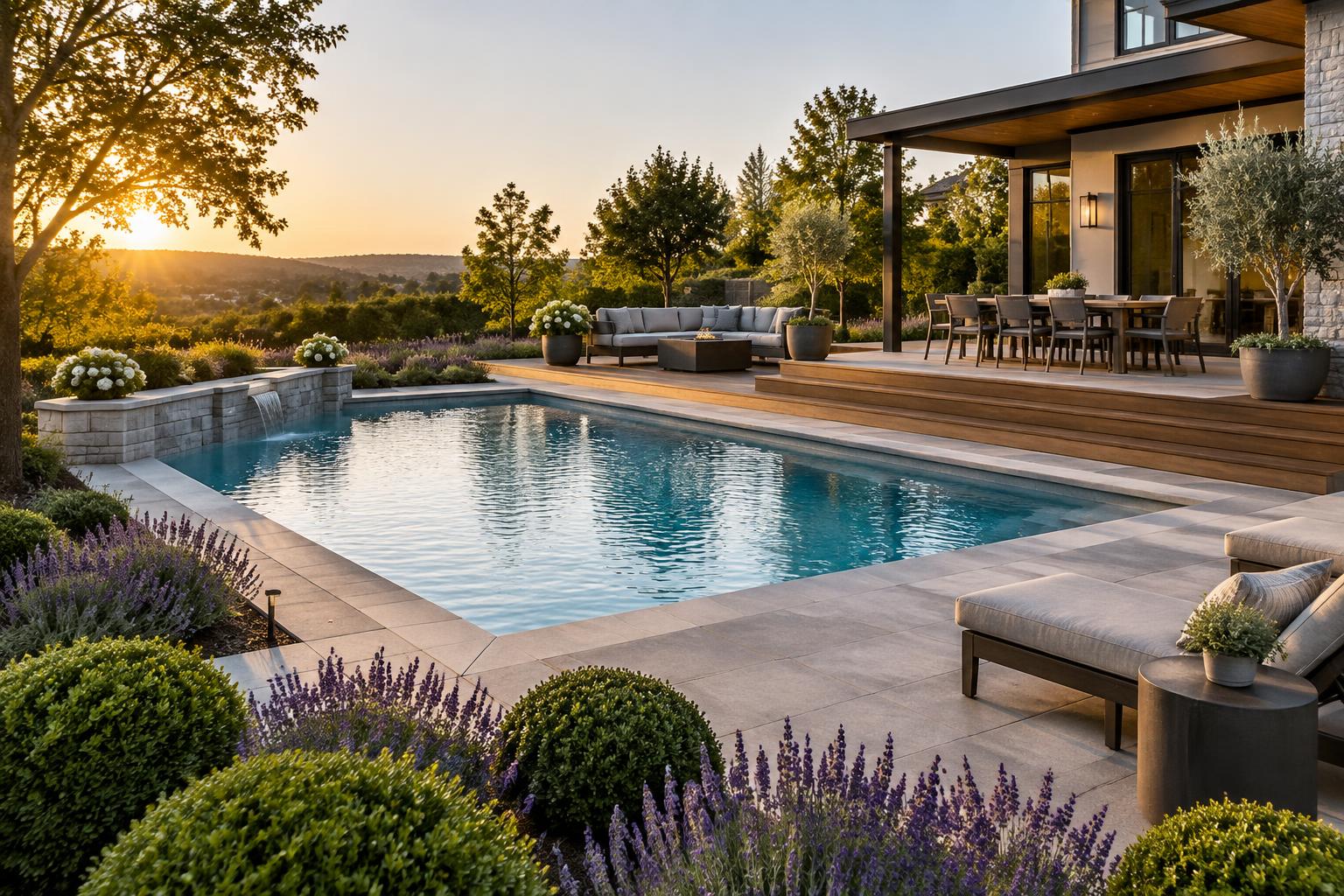
Modern backyard pool deck with light gray composite decking, travertine coping, lounge chairs, and a pergola at sunset
21 min read Fact Checked

The pool gets the budget. The deck decides whether anyone enjoys it. I have walked hundreds of backyards where the water looks perfect and nobody sits outside, because the surface around it is too hot to cross barefoot in July, too slick when it is wet, or so narrow that two chairs and a towel rack turn the walkway into an obstacle course.

A pool deck is the working floor of your backyard. It carries foot traffic, furniture, splash-out water, chlorine, sunscreen, freeze-thaw cycles, and the weight of everyone who ever stands around the grill. Get the material, the slope, and the dimensions right and it will outlast the pool liner two or three times over. Get them wrong and you are grinding out cracks or paying to resurface within five years.

This guide walks through the decisions in the order a contractor actually makes them: how much deck you need, which material fits your climate and budget, what the real installed costs look like in 2026, and how to keep the surface safe. It is written from the field, not from a brochure, and it assumes you want a deck that still looks good the summer your kids learn to dive.

What a Pool Deck Actually Is (and Why the Definition Matters)

A pool deck is the continuous walking surface that surrounds a swimming pool, starting at the coping — the capped edge that finishes the pool shell — and extending out to your lawn, patio, or house. It is a structural element, not decoration. It has to shed water away from the pool, support furniture and people without settling, and provide traction to wet bare feet.

The word deck confuses people because in most of the country a deck means elevated wood framing. Around a pool, deck usually means an at-grade surface: poured concrete, pavers, or stone laid over compacted base. Elevated wood or composite decking shows up mostly around above-ground pools, on sloped lots, and on the raised sections of a pool that is set into a hillside.

The distinction matters when you get quotes. An at-grade concrete deck is priced by square foot of flatwork over base. An elevated deck is priced by framing, footings, joist spacing, and railing — a completely different scope with completely different code requirements. When a contractor's number seems shockingly low or high, this is usually the reason.

One more piece of vocabulary worth knowing: the coping and the deck are separate line items. Coping is the two-inch to twelve-inch band that caps the pool wall and gives swimmers a handhold. You can pair travertine coping with a concrete deck, or bullnose paver coping with a composite deck. Mixing them deliberately is one of the cheapest ways to make a modest deck look custom.

How Much Deck Do You Actually Need?

This is the question homeowners answer last and regret first. Deck size is a furniture problem before it is a budget problem, and the numbers are less forgiving than they look on paper.

As a working rule, plan a minimum of four feet of clear walking surface on every side of the pool. Four feet lets a person walk past someone standing at the edge. Anything under three feet forces people to turn sideways and is the single most common complaint I hear about older pools.

Then add depth where you actually live. A lounge chair needs six feet of clear depth to be usable, including room to swing your legs out. A dining table for six needs a twelve-by-twelve-foot pad so chairs can pull back without a leg going off the edge. A grill or outdoor kitchen run needs at least five feet of standing space in front of it, more if it is a cooking zone where two people pass each other.

For a standard 16-by-32-foot rectangular pool, that math usually lands between 700 and 1,000 square feet of deck. Homeowners who budget for 400 end up with a walkway, not a backyard. If your lot cannot support that footprint, the fix is not to shrink the walkways evenly — it is to keep four feet on three sides and put all your remaining space into one generous sun deck or covered lounge on the side you use most.

  • Minimum walkway on all sides: 4 ft clear (3 ft absolute minimum where code and lot allow)
  • Lounge chair zone: 6 to 7 ft of depth, 3 ft per chair in width
  • Dining zone: 12 x 12 ft for a six-seat table with pull-back room
  • Grill or outdoor kitchen: 5 ft standing clearance, 8 ft if it is a two-cook layout
  • Diving board or slide runout: follow the manufacturer's clearance spec exactly, no exceptions
  • Typical total for a 16 x 32 pool: 700 to 1,000 sq ft

Pool Deck Materials Compared: Heat, Traction, Cost, and Lifespan

Every pool deck material trades one advantage for another. Concrete is cheap and rigid. Pavers are flexible and repairable but labor-heavy. Travertine stays cool and costs more. Composite resists rot but gets hot in direct sun. There is no universally correct choice — there is a correct choice for your climate, your soil, and how much maintenance you are honestly willing to do.

The table below is the comparison I walk clients through at the kitchen table. Surface temperature figures are approximate readings taken on light-colored samples in full afternoon sun at roughly 95°F ambient; darker colors of the same material can run 15 to 25 degrees hotter, which is a bigger factor than most homeowners expect.

MaterialInstalled cost / sq ftBarefoot heatWet tractionLifespanBest for
Broom-finished concrete$8 - $15HotGood25 - 30 yrsBudget builds, simple shapes
Stamped concrete$14 - $28HotFair (needs grit sealer)20 - 25 yrsHigh-end look on a slab budget
Concrete pavers$16 - $30WarmVery good30 - 50 yrsFreeze-thaw climates, repairability
Travertine$20 - $38CoolVery good40+ yrsHot, sunny regions
Flagstone / bluestone$25 - $45Warm to hotGood40+ yrsNatural, organic pool shapes
Composite decking$30 - $60Warm to hotGood25 - 30 yrsElevated decks, above-ground pools
Pressure-treated wood$18 - $35Cool to warmFair when wet10 - 15 yrsLowest-cost elevated framing
Porcelain pavers$25 - $45CoolExcellent (R11 rated)40+ yrsModern designs, stain resistance
Cool-deck / acrylic overlay$5 - $12CoolGood7 - 12 yrsResurfacing existing concrete
Source: Pool deck material comparison. Installed costs are 2026 national averages and vary significantly by region, access, and site prep.

Poured Concrete: The Default, and When It Is the Right One

Roughly two-thirds of the pool decks in this country are poured concrete, and there is a reason. It is the cheapest way to cover a large area with a durable, monolithic surface, it takes any shape you can form, and every contractor in your zip code knows how to place it.

The finish matters more than the concrete. A steel-troweled slab is beautiful and dangerously slick when wet — never accept one around a pool. A light broom finish, applied perpendicular to the direction of foot traffic, gives you real traction for essentially no extra cost. Salt finish and exposed aggregate are the other two safe classics; exposed aggregate in particular hides stains and small imperfections better than anything else.

Where concrete gets people in trouble is cracking. Concrete does not crack because it is bad concrete; it cracks because it shrinks as it cures and it moves as the ground beneath it moves. The control is in the details: four inches of thickness minimum, a compacted four- to six-inch gravel base, fiber mesh or rebar reinforcement, and control joints cut within 24 hours at intervals no greater than 8 to 10 feet. An expansion joint must separate the deck from the pool shell and from the house.

Color is a safety decision, not just a style one. A charcoal-stained concrete deck in Phoenix can hit 160°F on an August afternoon — hot enough to blister a child's feet in seconds. Stay light: buff, sand, bone, pale gray. If your heart is set on a dark tone, keep it to a border band that people cross rather than stand on.

Stamped concrete deserves its own caution. The pattern is pressed into the wet slab and then sealed, and standard high-gloss sealer turns that textured surface into a skating rink. If you go stamped, insist on a matte penetrating sealer with anti-slip grit broadcast into it, and plan to reseal every two to three years.

Concrete and Porcelain Pavers: The Repairable Choice

Pavers cost more up front than a slab and are worth it in more situations than most homeowners realize. They are individual units set on a compacted base with a sand or polymeric-sand joint, which means the surface flexes with ground movement instead of cracking.

That flexibility is the whole argument in cold climates. In Minnesota or upstate New York, frost heave will eventually crack a rigid slab; a paver field simply moves and settles back. And when a section does settle — near a downspout, over a trench where the plumbing ran — you lift twenty pavers, re-level the base, and set them back down. The repair is invisible. There is no such thing as an invisible slab repair.

Pavers are also the pragmatic choice when equipment or plumbing runs under the deck. Every pool eventually needs a line chased or a light conduit pulled, and lifting pavers costs a weekend instead of a demolition crew.

Porcelain pavers are the newer option and they solve the two things people dislike about concrete units. They stay noticeably cooler, they do not absorb sunscreen or leaf tannin, and the good ones carry an R11 or R12 slip rating, which is the European standard for wet barefoot areas. They cost roughly what natural stone costs and they need a very precise base, so this is not the material to hand to an inexperienced installer.

Whatever unit you choose, the base is the job. Six inches of compacted crushed aggregate for pedestrian areas, an inch of bedding sand screeded dead flat, a proper edge restraint on every free edge, and polymeric sand swept into the joints to lock the field and block weeds. Skipping the edge restraint is the most common failure I see, and it shows up as a wavy, spreading border about three seasons in.

Travertine and Natural Stone: Cool Underfoot, Higher Commitment

If you live somewhere the sun is a real adversary — Arizona, Nevada, Texas, Florida, inland California — travertine is the material worth stretching the budget for. It is a porous limestone that stays dramatically cooler than concrete in direct sun, often 20 to 30 degrees cooler than a comparable gray slab. Barefoot comfort is not a luxury detail around a pool; it determines whether the deck gets used at midday.

Travertine also has excellent wet traction in its tumbled or brushed finish, and the standard French pattern reads as expensive without any custom work. Buy it in the 1.25-inch paver thickness for deck use rather than the thin tile intended for interiors, and specify unfilled and tumbled for maximum grip.

The trade-off is porosity. Travertine drinks up spills, and around a pool that means sunscreen, iced tea, red wine, and iron from well water. Seal it with a penetrating impregnating sealer at installation and again every two to three years. Never use an acidic cleaner on it — no vinegar, no standard tile cleaner — because it will etch the surface permanently.

Bluestone and flagstone are the northern equivalents, and they suit freeform, naturalistic pools that are trying to look like a swimming hole rather than a resort. They are gorgeous. They also run hotter than travertine, vary in thickness enough to complicate a dry-laid install, and cost real money. If your design leans natural, pair the stone with soft edges and layered planting; the ideas in our backyard landscaping guide translate directly to poolside beds.

One structural note for any natural stone: mortared installations over a concrete slab are common in the South and effectively rigid. In a freeze-thaw region, a dry-laid installation over compacted base is a safer bet unless your contractor is genuinely experienced with a proper mortar bed and a bond-breaking membrane.

Wood and Composite Decking Around a Pool

Elevated decking is the right call in three situations: around an above-ground pool, on a lot that slopes enough that filling it would cost more than framing it, and where the pool sits at the same level as a raised rear entry and you want a continuous floor from the back door to the water.

Composite is the default now, and rightly so. It does not splinter, it does not need annual sealing, and modern capped composites resist chlorine and the sunscreen stains that ruin wood. Choose a board with a deep embossed grain rather than a smooth surface — the texture is what gives wet feet something to hold. And go light in color. Dark brown composite in full southern sun can reach surface temperatures that make it unusable from noon to four.

Pressure-treated pine is still the cheapest way to build an elevated deck, and it is fine if you accept the maintenance rhythm: a cleaning and a penetrating stain roughly every two years, and a board or two replaced along the way. Kiln-dried-after-treatment lumber is worth the upcharge because it moves less. Ipe and other tropical hardwoods are exceptional around water and priced accordingly.

Framing near a pool needs its own attention. Use hot-dip galvanized or stainless fasteners and joist hangers, because chlorine and salt systems chew through standard hardware. Cap the joists with self-adhering flashing tape so the framing does not sit in trapped splash-out water. And run boards with a small consistent gap so water drains through instead of pooling.

Whatever you build, the surrounding ground plane matters as much as the deck. Shade, screening, and planting turn a bare structure into a room — our outdoor living space guide covers how to zone those areas, and if the deck is overlooked by neighbors, fast-growing privacy hedges solve it for a fraction of what a fence extension costs.

The Two Numbers Nobody Asks About: Surface Heat and Slip Rating

Ask a contractor for the slip rating of the material they are proposing and watch what happens. In commercial aquatic work these numbers are specified as a matter of course. In residential work they are almost never mentioned, and the result is thousands of decks that are technically beautiful and functionally hazardous.

The relevant standard for barefoot wet areas is DIN 51097, which produces the ratings A, B, and C. Class B is the practical minimum for a pool surround; Class C is what you want on ramps, steps, and any slope. Porcelain pavers are usually the only residential product where the manufacturer publishes it outright, but tumbled travertine, broom-finished concrete, and textured pavers all perform in that range.

Heat is the other one. Light-colored travertine and porcelain typically read 105 to 115°F on a 95-degree day. Standard gray concrete runs 125 to 135°F. Dark stamped concrete and dark composite can exceed 150°F. The threshold where skin starts to be injured on contact is around 140°F, which is why the color of your deck is a safety spec and not just a design preference.

There are three practical mitigations, and I recommend all three: choose light colors, break up large expanses with shade, and give people a cool path. A pergola over the lounge zone, a sail over the shallow end, or a mature shade tree set back from the coping changes the usable hours of the whole backyard. So does a simple runner of cool material from the door to the water.

  • Target DIN 51097 Class B minimum, Class C on steps and ramps
  • Keep the deck light in color — every shade darker adds real surface temperature
  • Shade at least a third of the deck area by pergola, sail, awning, or tree canopy
  • Never use a high-gloss film-forming sealer on a walking surface
  • Add anti-slip grit additive when resealing stamped or overlay surfaces
  • Test barefoot at 3 p.m. in August before you sign off on a sample, not at 9 a.m. in May

Drainage: The Detail That Decides Whether the Deck Lasts

A pool deck moves an enormous amount of water. Splash-out, rain, backwash, and the runoff of everyone who climbs out at once all have to go somewhere, and where they go determines whether you are dealing with algae stains, heaving, or a wet basement in five years.

The baseline is slope. A pool deck should fall away from the pool at roughly a quarter inch per foot — about a two percent grade. That is enough to move water without being perceptible underfoot. Sloping toward the pool is a mistake that dumps dirt, fertilizer, and lawn chemicals straight into your water and forces the filter to work overtime.

Where the deck meets the house, slope must run away from the foundation, always. If your yard is flat or the pool sits below the house, you need a collection strategy rather than a slope strategy: a linear channel drain across the low edge, tied into solid pipe running to daylight or a dry well. Trench drains around the perimeter are standard on hardscape-heavy designs where there is nowhere for sheet flow to go.

Permeable joints help but do not replace drainage. A paver field with open-graded base absorbs a surprising volume of rain, and that is genuinely useful in a suburban yard. It is not, however, a substitute for grading, and it does nothing in saturated clay soil.

Finally, keep the expansion joint at the pool shell clean and sealed. That flexible joint between coping and deck is what allows the two structures to move independently. When it dries out and opens up, water gets underneath the deck, undermines the base, and starts the tilting that eventually cracks the coping. Re-caulking it takes an afternoon and it belongs on your seasonal home maintenance checklist.

Codes, Permits, and Barrier Requirements You Cannot Skip

Pool decks are regulated, and the rules vary enough by state and municipality that the only reliable answer is your local building department. That said, a few requirements are close to universal across the U.S. and worth knowing before you draw anything.

Barrier laws come first. Most jurisdictions require a barrier at least 48 inches high around a residential pool, with self-closing and self-latching gates that latch at least 54 inches above grade, and no gaps that pass a 4-inch sphere. If your deck design changes the grade on the outside of the fence, you may have effectively shortened the barrier and put yourself out of compliance without touching the fence itself.

Setbacks are next. Water and deck edges typically have to sit a set distance from property lines, septic fields, and easements. Adding 200 square feet of deck can push you over a lot-coverage or impervious-surface limit, which is common in the Southeast and in any watershed-protected district. Permeable pavers sometimes buy relief from those calculations, and that is worth asking about early.

Electrical rules around water are strict for good reason. The National Electrical Code requires equipotential bonding of the deck surface within three feet of the pool wall — a bonding grid tied to the pool's system — plus GFCI protection for outlets, and specific clearances for fixtures and overhead lines. This is licensed-electrician territory, not a weekend project.

And if you belong to a homeowners association, you likely need architectural approval for the deck, the fence, and any structure over it. The approval process is a paperwork exercise, and the same tactics that get landscaping applications approved work here — we covered them in detail in the HOA approval guide.

What a Pool Deck Really Costs in 2026

Published cost-per-square-foot numbers are only half the story, because the surface is usually 50 to 70 percent of the total. Base preparation, demolition, drainage, coping, and access all move the final invoice, sometimes by thousands.

Here is how a realistic 800-square-foot project prices out. Treat these as national averages: coastal metros run 25 to 40 percent higher, and much of the Midwest and South runs below.

ScopeLowTypicalHigh
Broom-finished concrete$6,400$9,200$12,000
Stamped concrete$11,200$16,800$22,400
Concrete pavers$12,800$18,400$24,000
Travertine$16,000$23,200$30,400
Porcelain pavers$20,000$28,000$36,000
Composite over framing$24,000$36,000$48,000
Acrylic resurfacing (existing slab)$4,000$6,800$9,600
Source: Estimated total installed cost for an 800 sq ft pool deck, 2026 national averages.

The Line Items That Blow Up a Pool Deck Budget

Every over-budget deck project I have seen went sideways on the same handful of items. None of them are exotic. They are simply invisible in a per-square-foot estimate, so homeowners do not plan for them.

Demolition of an existing deck is the biggest one. Breaking out, hauling, and disposing of an old concrete slab runs $3 to $8 per square foot before you have laid anything new. Access makes it worse: if a truck cannot reach the backyard and everything moves by wheelbarrow through a 36-inch gate, expect labor to climb 20 to 40 percent.

Coping is the second. Replacing coping when you replace a deck is almost always the right call — matching new deck to old coping rarely looks right — but it is a separate $40 to $90 per linear foot, which on a 16-by-32 pool is another $4,000 to $9,000.

Then there is base work. If the existing soil is soft, organic, or clay that holds water, the contractor has to over-excavate and bring in structural fill. That can be $1,500 to $5,000 and it is not optional; skipping it is how you get a settled deck in year two. Drainage improvements, a trench drain and pipe run to daylight, add $1,200 to $4,000. Bonding and electrical work for lights and outlets typically adds $800 to $3,000.

Budget a 15 percent contingency on any pool deck project. Underground work reveals surprises, and the honest contractors are the ones who tell you that before they start rather than after.

Design Ideas That Make a Modest Deck Look Custom

The difference between a builder-grade pool deck and one that photographs well is rarely money. It is three or four deliberate choices repeated consistently.

Start with a contrasting border. A single soldier course of paver or stone running the perimeter of a plain field — or a darker band framing a light concrete pour — instantly reads as designed. It costs a few hundred dollars in material and it is the highest-leverage move available.

Break up the field. A large uninterrupted expanse of any material looks like a parking lot. Insert a strip of turf, a band of river rock, or a run of planting beds between the pool surround and the dining area. It also reduces heat and gives water somewhere to go.

Extend the deck into a destination. A slightly raised lounge platform at the far end, a shaded pergola with an outdoor sofa, a small firepit patio just off the corner — these give the deck a reason to exist after the swimming stops in September. Layouts for these zones are worked out in our small backyard design ideas if your lot is tight.

Get the plant edge right. Skip anything that drops berries, sheds heavily, or has aggressive roots within six feet of the deck. Ornamental grasses, dwarf evergreens, agapanthus, and structured perennials handle poolside conditions and clean up easily. Fragrant, pest-deterring plants earn their spot too — several of the mosquito-repelling plants we profiled are ideal in containers along a deck edge.

And light it deliberately. Warm 2700K path lights, a few well-shielded uplights on specimen plants, and low step lights on every grade change give you a usable deck after dark and a safer one. Skip colored and blinking fixtures; they date a backyard faster than anything else on our list of outdated backyard trends.

Common Pool Deck Mistakes (and What They Cost to Fix)

These are the errors I am called out to look at most often. Every one of them is cheaper to avoid than to repair, and most of them come from a decision made to save a few hundred dollars at the start.

  • Slick finish: a troweled or high-gloss-sealed surface. Fix requires grinding or an overlay — $5 to $12 per sq ft.
  • Dark color in a hot climate: unusable midday. Fix means staining lighter or resurfacing entirely.
  • Deck too narrow: three feet or less on the primary side. Widening after the fact means matching a weathered material, which never quite works.
  • No expansion joint at the coping: leads to cracked coping and undermined base within a few seasons.
  • Slope toward the pool: dirty water, stressed filter, permanent staining at the waterline tile.
  • Skipped edge restraint on pavers: a spreading, wavy border by year three.
  • Wrong fasteners on elevated framing: chlorine-corroded hangers are a structural safety issue, not cosmetic.
  • Trees planted too close: roots lift pavers and crack slabs, and leaf litter stains porous stone.
  • Sealing too soon: new concrete needs 28 days to cure before any sealer goes on.
  • No shade plan: the most expensive deck in the neighborhood, empty from noon to four.

A Realistic Pool Deck Maintenance Calendar

Pool decks do not need much attention. They need the right attention at the right time of year, and most of it takes under an hour.

In spring, before the pool opens, sweep the whole surface and rinse it down. Inspect the expansion joint at the coping and re-caulk anything that has opened. Check paver joints for washed-out sand and refill with polymeric sand on a dry day. Look for the first hairline cracks in concrete and fill them with a flexible urethane crack filler while they are still narrow.

Through summer, rinse the deck after heavy use. Sunscreen and body oil build a film that gets slippery long before it looks dirty. A mild pH-neutral cleaner and a stiff brush handle it; pressure washing works too, but keep it under 1,500 psi on pavers and travertine and never hold the tip close enough to blast out joint sand.

In fall, get the leaves off promptly. Wet leaves left on porous stone leave tannin stains that take a specialty poultice to remove. Clear the drains and downspouts before the first real storm — this is the same walkthrough covered in our fall cleanup guide.

Before winter in freezing regions, blow out and cover the deck drains, and stop using rock salt anywhere near the deck permanently. Sodium chloride destroys concrete surfaces and pits stone. Use calcium magnesium acetate or plain sand for traction instead. The rest of your cold-weather list is in the winterizing guide.

On a multi-year cycle: reseal travertine and natural stone every two to three years, reseal stamped concrete every two to three years with grit added, and re-sand paver joints roughly every three to five years. That is the entire program.

Resurface or Replace? How to Decide on an Existing Deck

Not every tired pool deck needs to come out. Resurfacing an existing slab with an acrylic cool-deck coating, a micro-topping, or a thin paver overlay costs a third to a half of a full replacement, and on a structurally sound slab it is a genuinely good outcome.

The test is the base, not the surface. Walk the deck slowly and look for these signals: sections that rock or sound hollow underfoot, cracks wider than a quarter inch, cracks with vertical displacement where one side sits higher than the other, or a slab that has tilted toward the pool. Any of those mean the ground underneath has moved, and no coating fixes a moving base — it will telegraph through and crack again in one or two seasons.

If the slab is stable and the problems are cosmetic — surface spalling, discoloration, a finish that is too slick, dated stamped pattern — resurfacing is the smart money. An acrylic overlay adds texture and drops the surface temperature meaningfully. A thin porcelain or stone overlay bonded to a sound slab gives you a genuinely new deck at a fraction of the demolition cost.

One in-between option worth knowing: mudjacking or polyurethane foam lifting. If a section of an otherwise good slab has settled, injecting under it to raise it back level runs $500 to $2,000 and buys years. It is a real fix when settling has stopped, and a waste of money when it has not.

Hiring the Right Contractor and Reading the Bid

Pool deck work sits at the intersection of concrete, hardscape, drainage, and electrical, which means the quality gap between contractors is enormous. The good news is that the differences show up clearly in the bid document if you know what to look for.

A bid worth taking seriously specifies base depth and material, slab thickness, reinforcement type, joint layout and spacing, the exact finish, the slope, the drainage plan, coping detail, and the sealer product by name. A bid that says deck, 800 sq ft, concrete, $9,000 is telling you the contractor has not thought through the job, and every unspecified item becomes a change order later.

Get three bids and do not automatically discard the highest. Compare the scopes side by side; the expensive bid is frequently the only one that includes the drainage and base work the site actually needs. Verify license and insurance directly with your state board, not from a copy the contractor hands you, and confirm the pool electrical bonding is being handled by a licensed electrician.

Ask for two or three addresses of decks the crew built five or more years ago in the same material. New work photographs beautifully; five-year-old work tells you the truth about the base, the joints, and the sealer. And structure the payment schedule with a meaningful final payment held until you have walked the finished deck, run water on it to verify the slope, and seen it dry.

  • Confirm written scope: base depth, thickness, reinforcement, joints, finish, slope, drainage, coping, sealer
  • Verify state license and general liability plus workers comp insurance independently
  • Require a licensed electrician for bonding, GFCI outlets, and any deck lighting
  • Request addresses of 5-year-old installations in the same material
  • Ask who cuts the control joints and when — within 24 hours is the correct answer
  • Hold a final payment until you have water-tested the slope and inspected in daylight
  • Get the permit pulled by the contractor in their name, and get a copy

Frequently Asked Questions

What is the best material for a pool deck?

There is no single best material, but there is a best fit by climate. In hot, sunny regions travertine and light porcelain pavers win because they stay 20 to 30 degrees cooler underfoot than concrete. In freeze-thaw climates concrete pavers win because the flexible joints move with frost instead of cracking. On a tight budget in a moderate climate, a light-colored broom-finished concrete slab with a good base is genuinely hard to beat for durability per dollar.

How much does a pool deck cost per square foot?

In 2026, installed costs typically run $8 to $15 per square foot for broom-finished concrete, $14 to $28 for stamped concrete, $16 to $30 for concrete pavers, $20 to $38 for travertine, $25 to $45 for porcelain or flagstone, and $30 to $60 for composite over framing. Those figures cover the surface. Demolition, base correction, drainage, coping, and electrical are separate and can add several thousand dollars to an average project.

How wide should a pool deck be?

Plan four feet of clear walking surface on every side as a minimum, and expand from there based on furniture. A lounge chair area needs six to seven feet of depth, a six-seat dining table needs a 12-by-12-foot pad, and a grill run needs about five feet of standing clearance. For a standard 16-by-32-foot pool that usually totals 700 to 1,000 square feet of deck.

What is the coolest pool deck material for hot climates?

Light-colored travertine and light porcelain pavers consistently measure coolest, often 105 to 115°F on a 95-degree day, compared with 125 to 135°F for standard gray concrete. Acrylic cool-deck coatings over existing concrete are the budget option and drop surface temperature noticeably. In all cases the color of the material matters as much as the material itself.

Do I need a permit to build a pool deck?

Usually yes. Most jurisdictions require a permit for new hardscape around a pool, any elevated structure, and all electrical work. Permits also tie into barrier compliance, setbacks, and impervious-surface limits, all of which a new deck can affect. Call your local building department before design, and have the contractor pull the permit in their own name.

How do I stop my pool deck from being slippery?

Start with texture rather than treatment: a broom finish, tumbled travertine, textured pavers, or a porcelain rated R11 or higher. If the surface is already slick, options include grinding, an acrylic or micro-topping overlay with grit, or applying a penetrating anti-slip treatment. Never use a high-gloss film-forming sealer on a pool deck, and rinse off sunscreen and body-oil buildup regularly, because that film is often the real cause.

Which way should a pool deck slope?

Away from the pool at roughly a quarter inch per foot, or about a two percent grade, and away from the house foundation. Sloping toward the pool washes dirt, mulch, and lawn chemicals into the water. On flat lots where sheet flow has nowhere to go, use a linear channel drain along the low edge piped to daylight or a dry well.

Can I pour a concrete pool deck myself?

Small sections, yes, with help. A full pool deck is a poor DIY candidate because concrete placement is time-critical, the base and slope work is unforgiving, control joints must be cut within 24 hours, and the equipotential bonding grid near the pool is code-regulated electrical work. Pavers over a properly compacted base are the more realistic DIY route for a determined homeowner, though the excavation and compaction are still heavy work.

How long does a pool deck last?

With a sound base and routine maintenance, concrete lasts 25 to 30 years, concrete pavers 30 to 50, travertine and porcelain 40 or more, composite 25 to 30, and pressure-treated wood 10 to 15. Acrylic resurfacing coatings last 7 to 12 years. Base quality, drainage, and de-icing practices affect these numbers more than the material itself.

Should I replace the coping when I replace the deck?

In almost every case, yes. New deck material against weathered coping rarely matches in tone or profile, and replacing the deck alone often disturbs the coping bed anyway. Budget $40 to $90 per linear foot. It is also the moment to install a proper flexible expansion joint between coping and deck, which is what protects the whole assembly long-term.

Can pavers be installed over an existing concrete pool deck?

Yes, if the slab is structurally sound, drains correctly, and the added height does not create a trip hazard or reduce your barrier height. Thin pavers or porcelain can be bonded directly, or a bedding layer can be used over a slab that drains well. If the existing slab has moving cracks, hollow spots, or settling, remove it — an overlay will telegraph those failures within a season or two.

Is rock salt safe to use on a pool deck in winter?

No. Sodium chloride causes surface scaling on concrete, pits natural stone, corrodes metal fasteners and railings, and the runoff damages nearby plantings. Use calcium magnesium acetate or plain sand for traction instead, and keep the deck clear of snow buildup so ice has less chance to form.

Does a pool deck add value to a home?

A well-built, well-sized deck is what makes a pool feel like usable living space rather than a maintenance obligation, and buyers respond to that. Appraisers rarely assign a separate value to the deck itself; the value shows up in how the pool area presents overall. A cracked, narrow, or slippery deck actively reduces what buyers will offer for a home with a pool, so the condition matters more than the material.

Conclusion

The best pool decks are not the most expensive ones — they are the ones where somebody thought hard about heat, traction, width, and water before choosing a color. Start by measuring the furniture you actually plan to use, then pick the lightest-colored material your climate and budget support, then spend whatever is left on base and drainage rather than on upgrades you can see. That order is what separates a deck that still looks right in fifteen years from one you resurface in five. When you are ready to design the space around it, keep going with our outdoor living space guide for zoning and shade, the small backyard design ideas if your lot is tight, and the full Outdoor Living collection for everything that turns a poolside slab into the part of the house everyone actually uses.

Share

About the author

David Nguyen

Contributor

David has over a decade of experience in residential yard maintenance and garden planning. He specializes in low-maintenance planting plans that add lasting value.

More from David Nguyen

Published · Updated

Weekly newsletter

Fresh home & garden ideas, every Sunday.

Join American homeowners getting practical, research-informed advice on gardening, landscaping, and DIY. Free, no spam, unsubscribe anytime.